
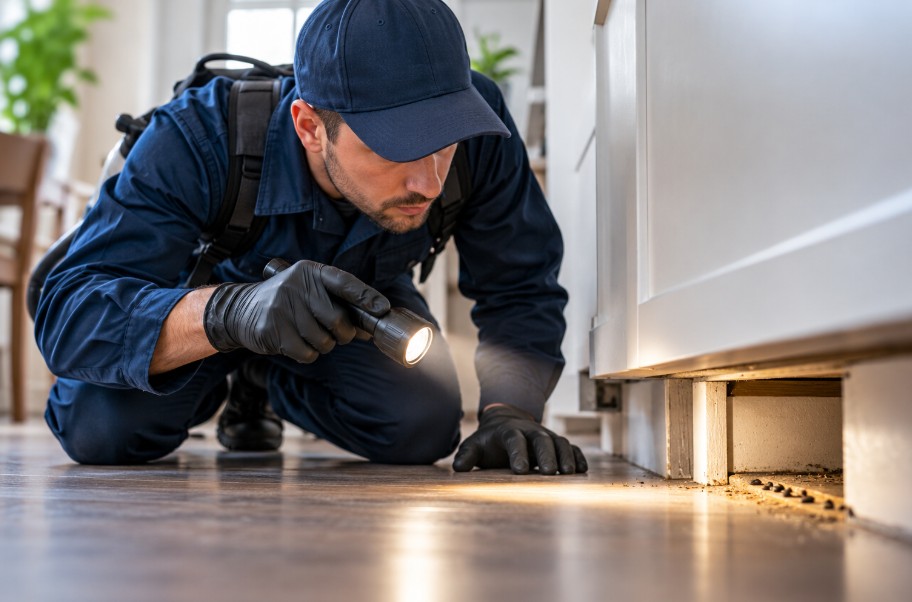
Rodent Inspection in Lincoln, NE: Find Out What's in Your Walls — and How It Got In
A noise in the ceiling tells you something is there. It doesn't tell you what it is, how many there are, where they're nesting or which gap they squeezed through. That's what a rodent inspection is for.
Lincoln Rodent Control Co. does mouse and rat inspections across Lincoln around the clock. We're open 24/7, and in most cases our inspector is at your door within about 60 minutes of your request. We go through the house top to bottom, read the evidence the animals left behind, and hand you a clear answer: what you have, how bad it is, how they're getting in, and what it will take to fix.
-
The species — house mouse, deer mouse, Norway rat, squirrel or something else
-
Whether the activity is fresh or old, and roughly how large the problem is
-
Every entry point we found, marked and photographed
-
Where they're nesting, eating and traveling inside the house
-
A written plan and quote — yours to keep whether you hire us or not
Rodent Inspection in Lincoln at a Glance
| Detail | Answer |
|---|---|
| How fast | An inspector at your door in about 60 minutes |
| Hours | Open 24 hours a day, 7 days a week, including holidays |
| What we inspect for | House mice, deer mice, Norway rats, squirrels and voles |
| What we check | Foundation, roofline, attic, living areas, kitchen, basement or crawl space, garage, utility areas and outbuildings |
| What you get | Photos of every entry point, a written report and an itemized quote |
| Cost | Quoted upfront, before we come out |
| Who it's for | Homeowners, home buyers and sellers, landlords and Lincoln businesses |
| Where | All of Lincoln, plus Waverly, Hickman, Bennet, Firth, Malcolm and Raymond |
Do You Need an Inspection or Removal?
Both — and in that order. Removal that starts without an inspection is guesswork: traps go in the wrong places and the gap the animals use stays open. If our inspection finds active mice or rats, we can start removal and sealing the same visit once you approve the plan. If it finds nothing active, you've paid only for the inspection and you know your home is clear.
When Lincoln Homeowners Should Book a Rodent Inspection
You've Seen or Heard Something
Droppings in a drawer, scratching above the bedroom, a chewed corner on a cereal box, the dog fixated on the stove. Any one of these is reason enough. Rodents are mostly active at night and good at staying hidden, so the first sign you notice usually isn't the first one they've left.
It's Fall and Your House Has a History
If mice showed up last October, they'll likely try again this October unless the opening they used was found and closed. A pre-season inspection in late summer or early fall lets us seal things before nights in Lincoln drop below freezing and the indoor push starts.
You're Buying or Selling a Home
The pest report that often comes with a home sale is a wood-destroying insect (termite) report, usually because a lender or the purchase agreement calls for it. It covers termites and similar insects, not mice or rats. A general home inspector may mention droppings in passing but won't trace entry points or judge how active the problem is. A separate rodent inspection fills that gap before you close — or, for sellers, before a buyer's inspector finds it first.
You Rent Out Property
Under Lincoln's housing code, landlords are responsible for preventing rodent infestations and for getting rid of them when they happen, unless that duty has been specifically placed on the tenant. Tenants can take unresolved problems to the City's Building and Safety housing section. An inspection between tenants, or as soon as a renter reports a problem, gives you documentation and a fix before it becomes a code complaint.
You Run a Food Business or Commercial Building
The Lincoln-Lancaster County Health Department inspects restaurants, grocery stores and food warehouses, and Lincoln restaurants have been cited in those inspections for mouse droppings. Our commercial inspections help you find problems before the health inspector does.
Treatment Didn't Work
If you've been trapping for weeks, or another company has come and gone, and you're still catching mice, something was missed. A second-opinion inspection focuses on finding the entry point or nesting area the first plan didn't account for. Check our rodent trapping page.
Mouse Inspection vs. Rat Inspection in Lincoln
Mice and rats leave the same kinds of clues, but at very different sizes and in different places. Knowing which one you have changes everything that follows, so this is the first question every inspection answers.
| Clue | House mouse | Norway rat |
|---|---|---|
| Droppings | About 1/8–1/4 inch, pointed ends, scattered | About 3/4 inch, blunt ends, often in clusters |
| Tooth marks | Fine grooves about 1–2 mm wide | Wider grooves around 4 mm |
| Chewed holes in boxes | Small, about 1½ inches, clean edges | 2 inches or more, rough and torn |
| Footprints in dust | 3/8 inch or smaller | Roughly 3/4 to 1½ inches |
| Burrows outside | Rare; small (about 1 inch) when present | Common; about 3 inches, along foundations, stoops and woodpiles |
| Where activity shows up | Kitchens, cabinets, wall voids, attics, anywhere in the house | Basements, crawl spaces, garages, ground level |
What a Mouse Inspection in Lincoln Focuses On
Mice climb well and can live anywhere from the sill plate to the attic, so a mouse inspection covers the whole house. We pay extra attention to kitchens, utility penetrations, garage corners and attic insulation, and we look for small, scattered droppings that tell us how far they've spread. We also check whether the mice are house mice or deer mice, since deer mice — more common on acreages and at the edge of town — call for more careful cleanup.
What a Rat Inspection in Lincoln Focuses On
Norway rats are the only rats you're likely to find in Lincoln, and they live low. A rat inspection spends more time outside: burrows along the foundation and under slabs, runways worn through grass, gnawing on garage doors and wood trim, and food sources like bird feeders, dog runs, compost and trash. Indoors, we look at basements, crawl spaces, floor drains and gaps under doors. Rats need more food and water than mice and travel the same paths every night, so their routes are usually easier to map.
Attic and Squirrel Inspections
If the noise is overhead and comes early in the morning or late afternoon, it may be a fox squirrel rather than mice. Squirrel inspections focus on the roofline: chewed soffits, fascia boards, roof returns, gable vents and branches touching the house.
How Our Rodent Inspection Works, Start to Finish
Before We Arrive
When you request an inspection, we ask a few quick questions: what you've seen or heard, where, when it started, and whether you have pets or small children. That tells our inspector where to start and what to bring. Within about 60 minutes, someone is at your door — day or night.
We Listen First
The inspection starts with a short conversation. You know your house: which room the scratching comes from, where the dog keeps sniffing, when the noise is loudest. Those details save time and point us to the right walls.
Outside, Then Inside
We always start outdoors, because that's where rodents get in. We walk the full perimeter at ground level, then look up at the roofline. Inside, we follow a set route — attic, living areas and kitchen, basement or crawl space, then the garage — so nothing gets skipped.
Following the Trail
Rodents build nests close to food and travel the same paths between the two every night. Instead of checking random spots, we find the food sources first, then work outward along walls and pipes until we find where they're hiding and how they're getting in.
Reading How Fresh It Is
Old droppings and an active infestation look different up close. Fresh droppings are dark and soft; old ones are gray and crumbly. New gnawing on wood is light-colored and rough; old gnawing darkens and wears smooth. This is how we tell you whether you have mice now or just evidence of mice from three winters ago.
The Walkthrough With You
Before we leave, we walk you through what we found — photos on the spot, entry points pointed out, nesting areas shown — and explain what we recommend and why. You get a written plan and price. There's no pressure to decide that day.
How Long It Takes
A typical single-family home takes about an hour. Larger homes, houses with crawl spaces, acreages with outbuildings and commercial buildings take longer.
Evening and Overnight Inspections
Because we're open 24/7, we can inspect when rodents are actually active. An evening visit is often the fastest way to confirm a rat problem or pinpoint where the noise in a wall is coming from.
Hearing something right now? We can be there within about 60 minutes, any hour.
Book a Rodent InspectionWhere We Inspect in Your Lincoln Home
Here's the checklist our inspector works through on a typical house. Not every home has every area, and we'll add anything specific to yours.
Foundation and Ground Level
- Every spot where a pipe, wire, gas line, AC line or cable enters the house
- Cracks in poured foundations and loose mortar in brick or stone foundations
- Where siding meets the foundation, and corners where trim has pulled away
- Window wells, basement windows and old coal chutes
- Dryer, bathroom and kitchen exhaust vents
- Gaps under exterior doors — anything more than about 1/4 inch is an open door for a mouse
- Burrows under stoops, porches, slabs, sheds and decks
Roofline and Upper Exterior
- Soffits, fascia and roof returns, where squirrels and mice often chew in
- Gable vents, ridge vents and roof vents
- Gaps where additions or porches meet the original house
- Tree limbs, vines, downspouts and utility lines that give rodents a way up
Attic
- Tunnels, flattened areas or nests in the insulation
- Droppings along the top plates and near the eaves
- Chewed wiring, especially near junction boxes
- Daylight showing through vents or roof edges
Kitchen and Living Areas
- Under and behind the stove, refrigerator and dishwasher
- The voids under kitchen and bathroom sinks
- Pantry shelves, drawers and the toe-kick space under cabinets
- Baseboard gaps, closets and spots where pets keep sniffing
Basement and Crawl Space
- The sill plate, where the house framing sits on the foundation — one of the most common mouse highways
- Rub marks along beams and joists
- Torn vapor barriers and burrowing in dirt floors
- Floor drains, sump pits and gaps around plumbing
- Storage boxes, which mice love to nest in
Garage
- Bottom seal and side seals on the overhead door, especially at the corners
- The door between the garage and the house
- Stored birdseed, grass seed, pet food and anything in cardboard
- Vehicles and mowers parked for long periods, which can hide nests under the hood
Utility and HVAC Areas
- Around the furnace, water heater and laundry hookups
- Cold-air returns and ductwork, particularly in basements and garages
- The dryer vent run from the machine to the outside wall
Outbuildings and Yard
- Sheds, detached garages, barns and pole buildings on larger lots
- Woodpiles, compost bins, gardens, bird feeders and dog runs
- Runways through grass and vole damage along foundations and young trees
The Signs We Look For and the Tools We Use
Ten Kinds of Rodent Evidence
A good inspection doesn't rely on droppings alone. Our inspectors look, listen and smell for all of these:
- 1 Droppings
- 2 Gnaw marks
- 3 Burrows
- 4 Runways — worn paths through dust, grass or insulation
- 5 Footprints and tail drag marks
- 6 Grease or rub marks along walls, pipes and joists
- 7 Urine staining
- 8 Live or dead rodents
- 9 Sounds — squeaking, scratching, gnawing
- 10 Odor, especially the musky smell of a long-running mouse problem
One sign can be misleading. Several signs in the same area tell a clear story.
Inspection Tools
- Bright flashlights for dark corners, attics and crawl spaces
- Ultraviolet (black) light to spot urine trails that glow under UV — we use it to confirm what we've already seen, not as the only proof
- Inspection mirrors and a borescope camera to see behind appliances and inside wall cavities without tearing anything open
- Non-toxic tracking powder in suspected runways when we need to confirm which way rodents are traveling
- Moisture meter to find leaks that give rodents water
- Camera to photograph every entry point and sign for your report
How Active Is It? Checking Burrows and Runways
When we find a burrow or a suspected entry hole outside, we may loosely plug it with paper or soil and check it again later. If it's been reopened, it's active. This simple test keeps you from paying to treat a hole nobody's using.
Why We Don't Guess at Numbers
People often ask, "How many are there?" Honestly, no one can count rodents from droppings. What we can tell you is whether the signs are fresh or old, scattered or heavy, in one room or throughout the house. When the evidence points to more than a few animals, we plan for more rather than less — underestimating is the most common reason rodent control fails.
Rodent Inspections for Every Kind of Lincoln House
No two Lincoln neighborhoods get rodents the same way. Our inspectors adjust where they spend their time based on how and when your house was built and what's around it.
| Type of property | Where you'll find it | What we look at hardest |
|---|---|---|
| Homes built roughly 1890–1940 | Everett, Near South, Hartley, Clinton, Havelock, University Place, Bethany | Stone and brick foundations with loose mortar, open wall cavities that run from basement to attic, old chutes and utility holes, settled doors |
| Post-war and mid-century ranches | Eastridge, Arnold Heights and other 1950s–60s subdivisions | Aging garage door seals, unscreened gable and soffit vents, decades of foam-patched pipe holes, basement window wells |
| Newer homes beside open ground | Yankee Hill, Wilderness Hills, Fallbrook and new streets on the city's edge | Unsealed utility entries, ridge vents without guards, garage corners, mice moving in from graded fields |
| Homes along creeks and trails | Near Salt Creek, Antelope Creek, Dead Man's Run and park corridors | Rat burrows along foundations and under slabs, crawl spaces, ground-level gaps |
| Rentals, duplexes and apartments | Near downtown and the university campuses | Shared walls and utility chases, trash areas, gaps between units — plus documentation for owners |
| Acreages and small-town homes | Waverly, Hickman, Bennet, Firth, Malcolm, Raymond | Outbuildings, stored feed and seed, deer mice, equipment and vehicles in storage |
Why It Matters Which House You Have
In a 1910 bungalow, the problem is usually many small gaps spread around an old foundation. In a five-year-old house near a field, it's more often one or two utility openings the builder never sealed. Knowing that going in means a faster, more accurate inspection — and a repair plan that fits your house instead of a generic one.
Your Rodent Inspection Report
Every inspection ends with a written report you can keep, forward to a landlord or real estate agent, or use to get other quotes.
What's in the Report
- What we found: species identified, and whether activity is current or old
- How serious it is: light, moderate or heavy, and which parts of the house are affected
- Entry points: each one listed with a photo and its location
- Nesting and travel areas: where rodents are living and the routes they use
- Conditions that attract them: food, water and clutter we noticed, with simple fixes
- Damage noted: chewed wiring, soiled insulation, gnawed wood or vents
- Health and cleanup notes: any areas that need careful cleanup, and how to handle them safely
- Our recommendation and price: removal, sealing and cleanup, itemized
What Happens Next
You decide. Some customers have us start removal and sealing the same day. Some take the report and handle small fixes themselves. Buyers often hand it to their agent to negotiate repairs. If we find no rodent activity, we'll tell you that plainly — and point out anything worth sealing so it stays that way.
If You Hire Us
Our inspection becomes the work plan. Traps go exactly where we found activity, sealing targets the entry points we photographed, and follow-up visits check those same spots until the house is clear.
Get a clear answer about what's in your house — and a written plan to fix it.
Specialty Rodent Inspections in Lincoln
Pre-Purchase Inspections for Home Buyers
We can inspect during your inspection contingency period and get you a written report quickly, so you have time to ask the seller for repairs or credits. Older homes, homes with finished basements and homes on acreages are the ones where buyers most often find surprises.
Pre-Listing Inspections for Sellers
Finding and fixing a rodent problem before your house goes on the market avoids a last-minute repair request — and gives you a clean report to show buyers.
Rental and Move-Out Inspections
For landlords and property managers: inspections between tenants, after a tenant complaint, or across a whole building. We document conditions with photos and dates, which helps if there's ever a question about when a problem started.
Commercial Inspections
Restaurants, food storage, offices, churches, schools and warehouses. We inspect storage rooms, kitchens, loading doors, drop ceilings and dumpster areas, and provide records you can show a health inspector or corporate auditor. Ongoing scheduled inspections are available.
Follow-Up and Seasonal Inspections
After removal and sealing, a follow-up inspection confirms the work held. Many homeowners near fields, creeks or with older foundations also book a yearly check in late summer, before the fall rush.
Why Book Your Rodent Inspection With Us
We Get There Fast, Day or Night
You shouldn't have to wait days to find out what's in your walls. We're open 24/7 and usually arrive within about 60 minutes — including evenings, when mice and rats are most active and easiest to confirm.
Rodents Are Our Only Focus
We don't inspect for ants, spiders or termites on the side. Every inspection we do is about mice, rats, squirrels and voles, and that focus shows in what we catch.
Based in Lincoln
Our base is at 5030 Fremont Street in University Place. We know how a Havelock bungalow, an Eastridge ranch and a new build near Yankee Hill each let rodents in.
Proof, Not Just a Verdict
You see the photos of every entry point and sign we find. You keep the report, whether you hire us or not.
No Pressure
We explain what we found and what we'd recommend, then let you decide. If there's no activity, we tell you that.
Rodent Inspection Areas We Serve
Lincoln Neighborhoods
We inspect homes and businesses in every part of Lincoln, including University Place, Bethany, Havelock, Clinton, Hartley, Near South, Everett, Antelope Park, College View, Country Club, Eastridge, Arnold Heights, Air Park, Capitol Beach, Fallbrook, Highlands, Yankee Hill, Wilderness Hills, Pine Lake, Williamsburg, downtown, Haymarket and the neighborhoods around both university campuses.
Nearby Towns
We also cover Waverly, Hickman, Bennet, Firth, Malcolm and Raymond. On acreages we include sheds, barns, garages and equipment storage in the inspection.
How to Get Ready for Your Inspection
- Leave the evidence where it is. Don't clean up droppings or throw out chewed items before we arrive — they tell us a lot. If you must clean, never sweep or vacuum droppings; spray them with disinfectant, let it soak, and wipe with paper towels while wearing gloves.
- Clear a path to the attic hatch, crawl space entrance, water heater and the area under the kitchen sink.
- Note what you've noticed: where, what time of day, and when it started.
- Secure pets in a room we won't need to enter.
- Tell us about any traps or bait you or a previous company put out.
Quick Self-Check Before You Book
Not sure whether you need an inspection? Spend ten minutes with a flashlight:
- ✓ Look behind and under the stove and fridge, and in the back of the under-sink cabinet.
- ✓ Check the garage door corners from inside with the lights off — if you can see daylight, a mouse can get in.
- ✓ Look at the dryer vent flap outside. Does it close fully?
- ✓ Check boxes stored in the basement or garage for chewed corners or shredded paper.
- ✓ Listen at night in the room where you suspect activity.
Find anything? Book an inspection. Find nothing but still hear noises? Book one anyway — the most active spots are usually the ones you can't see.
Rodent Inspection FAQs
Got questions about having your Lincoln home or business inspected for rodents? Here are straightforward answers to what property owners ask us most.
How fast can you inspect my Lincoln home?
We're open 24 hours a day, 7 days a week, and in most cases an inspector arrives within about 60 minutes of your request.
What does a rodent inspection cost?
It depends on the size of the property and what needs to be checked — a single-family home is quicker than an acreage with outbuildings or a commercial building. We'll tell you the inspection cost upfront before we come out.
Don't home inspectors already check for rodents?
A general home inspector may note droppings they happen to see, and the standard real estate pest report covers wood-destroying insects like termites. Neither one is designed to trace entry points or judge how active a rodent problem is. A dedicated rodent inspection does.
Can you tell if it's mice or rats?
Yes, in nearly every case. Droppings, tooth marks, footprints and where the activity shows up are very different between the two.
Will you cut into my walls?
No. We use inspection mirrors and cameras to see into voids without damaging anything. If we ever think opening a wall would help, we'll explain why and ask first.
Do I need to be home?
It's best if you are, so we can ask questions and show you what we find. For rentals or homes you're buying, a landlord, agent or property manager can let us in, and we'll send the report afterward.
Is the inspection safe for kids and pets?
Yes. An inspection is a look-and-document visit. If we use tracking powder, it's non-toxic and placed only where needed.
What if you don't find any rodents?
Then we'll tell you so. We'll also point out weak spots worth sealing and what else might explain the noise — settling, plumbing, birds or insects.
Do you inspect outside Lincoln city limits?
Yes — including Waverly, Hickman, Bennet, Firth, Malcolm and Raymond.
Can you inspect today?
In most cases, yes. Request an inspection any time and we'll usually be there within about 60 minutes.
If you find mice or rats, do you remove them too?
Yes. Removal, sealing and cleanup are what we do after the inspection. With your approval, we can often start the same visit.
Can you do a rodent inspection for a house I'm buying?
Yes. We'll coordinate access with your agent, inspect during your inspection contingency period and send a written report you can use in negotiations.