
Rodent Exclusion in Lincoln, NE — We Seal Your House So Mice and Rats Can't Get Back In
Traps catch the mice already inside. Sealing decides whether more show up next month. Lincoln Rodent Control Co. finds the gaps rodents use to get into your home and closes them with metal, mesh and mortar they can't chew through — from the foundation to the roofline.
What Rodent Exclusion Actually Means
Rodent exclusion — also called rodent-proofing or sealing — is building work, not pest spraying. We find every opening a mouse, rat or squirrel can use, then close it permanently. A mouse can get through a gap just over 1/4 inch wide; a rat needs a little over 1/2 inch. A tree squirrel needs about 1 1/2 inches and will chew a smaller hole bigger. So exclusion is about finding a lot of small openings, not just a few big ones.
Nebraska Extension calls rodent-proof construction the first and most important step in reducing rodent damage, noting that rodents come back through unsecured openings after control work. Done right, exclusion is the closest thing to a permanent fix. Removal handles today's animals; a sealed house stops the next ones.
Why Lincoln Houses Open Up Over Time
Most homes aren't built rodent-tight, and the ones that start out tight don't stay that way. In Lincoln, a few local forces keep creating new gaps.
Clay Soil and Freeze-Thaw Winters
Much of the Lincoln area sits on silty loess soils with clay-rich subsoil, which swells when it's wet and shrinks as it dries. Add winters that freeze and thaw over and over, and foundations shift a little year after year. That movement opens hairline cracks, pulls mortar out of brick and stone, and leaves new gaps where siding meets the foundation.
Garage Slabs That Heave
Frost and soil movement tilt garage floors over the years. When the slab is no longer level, the overhead door's bottom seal touches the floor in the middle but leaves a gap at one corner — exactly where mice get in.
Soft Seals Wearing Out
Rubber door seals, vinyl weatherstripping, caulk and spray foam all break down with Nebraska's sun, heat and cold. Rodents also chew right through rubber and vinyl. What looked sealed five years ago often isn't now.
New Holes Nobody Patched
Every new cable, internet, gas or AC line drilled through a wall leaves an opening. So do removed dryer vents, old phone lines and abandoned coal chutes in older Lincoln basements. Installers rarely seal them to a rodent-proof standard.
How the House Was Built
Some gaps were there from day one: the space between siding and the top of the foundation, open joints where two rooflines meet, gable vents with thin screens, and soffits that don't quite meet the fascia.
Where We Seal Lincoln Homes, From the Roof Down
We work top to bottom and outside to inside, so nothing gets skipped. These are the spots we seal most often and how we close each one.
Roofline and Attic Entry Points
| Entry point | How we seal it |
|---|---|
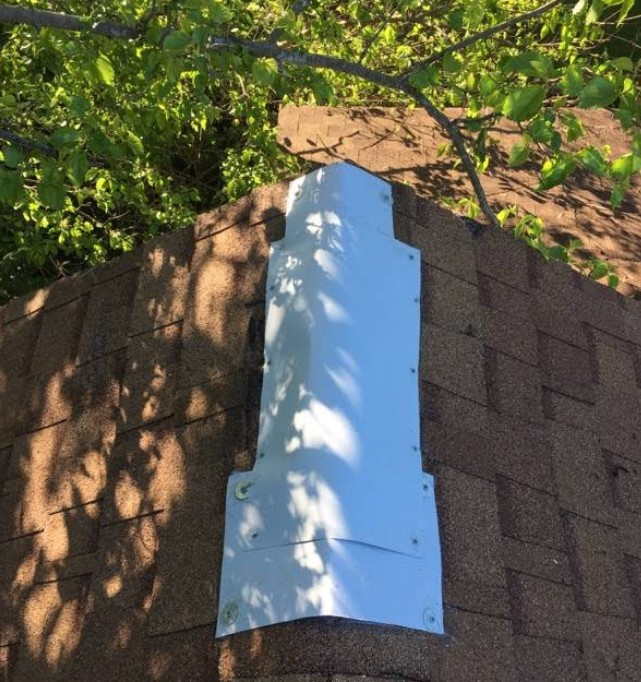
| Gaps where two rooflines meet (roof returns) | Custom-bent metal flashing fastened over the opening |
| Soffit and fascia gaps, chewed soffit corners | Metal patch or hardware cloth behind the soffit, then repair the panel |
| Gable vents | Heavy 1/4-inch galvanized hardware cloth fastened inside or over the vent |
| Roof vents and plumbing vent stacks | Metal vent guards and stack caps sized to the pipe |
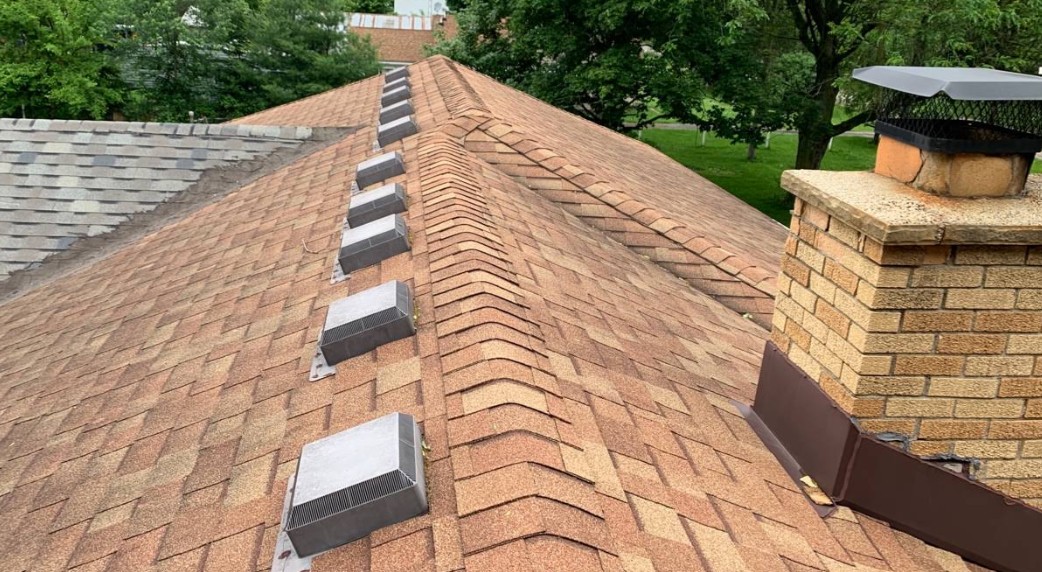
| Ridge vents | Rodent-resistant ridge vent guards that keep the attic ventilated |
| Chimneys | Stainless steel chimney cap with mesh, after the flue is confirmed working |
| Gutter line and builder's gap under the roof edge | Metal flashing or mesh closed along the full length |
Exterior Walls
| Entry point | How we seal it |
|---|---|
| Utility lines — cable, internet, phone, electric | Copper mesh packed tight, then sealant or a metal collar |
| AC refrigerant lines and gas lines | Copper mesh and sealant, or a split metal collar |
| Hose bibs and outdoor faucets | Mesh and sealant around the pipe |
| Dryer, bath and kitchen exhaust vents | Code-compliant vent caps with dampers, never a screen over a dryer vent |
| Siding corners and trim pulled away | Mesh behind, metal flashing or sealant in front |
| Old, unused holes from removed lines | Mesh-backed patch or metal plate |
Foundation and Ground Level
| Entry point | How we seal it |
|---|---|
| Gap between siding and foundation | Galvanized metal flashing along the joint |
| Foundation cracks and loose mortar | Mortar or masonry patch, reinforced with mesh on larger gaps |
| Window wells and basement windows | Metal well covers, repaired frames and screened openings |
| Old coal chutes and abandoned openings | Mortar, masonry or a metal plate |
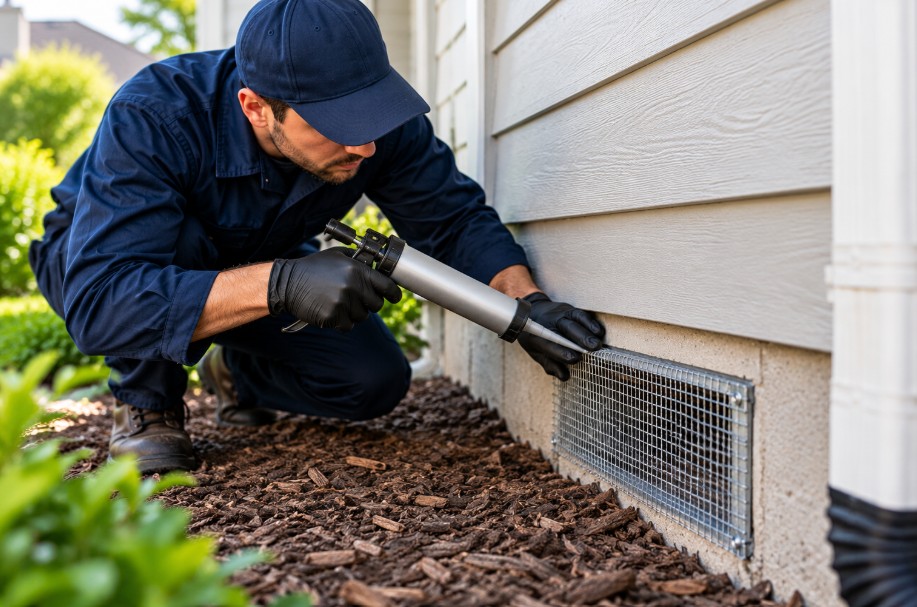
| Crawl space vents and access doors | 1/4-inch hardware cloth on vents; tight-fitting, metal-edged access doors |
| Brick weep holes | Stainless steel weep inserts that let water out but keep rodents out |
| Rat burrows along slabs and stoops | Buried hardware cloth barrier (an L-shaped skirt) along the slab edge |
Garage
| Entry point | How we seal it |
|---|---|
| Overhead door bottom corners | Rodent-resistant bottom seal, and corner seals or brush seals where the slab has heaved |
| Door sides and top | Side and top seals; gaps between the track and the wall closed |
| Service door to the yard | Metal door sweep or threshold so the gap is under 1/4 inch |
| Wall shared with the house | Pipes, wires and duct holes through that wall sealed with mesh and sealant |
Inside the House
Some gaps are easier to close from inside, and some routes connect rooms even after the outside is sealed.
- Pipe holes under kitchen and bathroom sinks
- Gaps behind the stove, refrigerator and dishwasher where lines enter the wall
- Cold-air returns, especially in garages and basements — 1/4-inch hardware cloth behind the grille
- Where pipes, ducts and wires pass from the basement or crawl space into the floors above
- Openings around the water heater, furnace and laundry hookups
- Attic hatches and gaps around ceiling penetrations
- Shared walls and utility chases in duplexes and apartments
The Materials We Seal With
A rodent's front teeth can't get a grip on a flat, hard surface, but give them a soft edge and they'll chew through quickly. Our materials are chosen to leave them nothing to bite.
Copper mesh
Packed tight into pipe and wire gaps. It doesn't rust like steel wool, and rodents can't pull it apart.
Galvanized hardware cloth (1/4-inch)
For vents, crawl space openings, cold-air returns and as backing behind patches on larger holes. Anything bigger than 1/4 inch lets mice through.
Galvanized sheet metal and flashing
Cut and bent on site to cover roof returns, siding-to-foundation gaps and chewed corners.
Mortar and masonry patch
For foundation cracks, stone and brick joints, and old coal chutes. Larger patches get a mesh backing for strength.
Metal door sweeps, garage seals and thresholds
To keep door gaps under 1/4 inch.
Stainless weep inserts, chimney caps and vent guards
Made to block rodents without blocking water, smoke or air.
Exterior-grade sealant
Used over mesh and metal to finish the seal and stop drafts, never as the barrier itself.
What We Don't Rely On
-
Spray foam on its own. Mice chew straight through it. We use foam only as filler behind mesh or metal, never as the barrier.
-
Steel wool. It rusts, shrinks and stains siding within a season or two. Fine as a temporary plug, not a permanent seal.
-
Caulk alone on a gap rodents are using. It's soft enough to chew.
-
Rubber and vinyl seals in high-traffic spots without metal protection.
-
Plastic weep covers and thin window screen that rodents chew through.
How a Rodent-Proofing Job Works
1. We Map Every Opening
We walk the outside of the house at ground level and along the roofline, then check the attic, basement or crawl space, garage and utility areas. Every gap gets photographed and noted, with its size and what's been using it. You see the full list before any work starts.
2. We Decide What Gets Sealed When
Order matters. If rodents are living inside right now, sealing every hole at once can trap them in your walls, where they die and smell — or, with squirrels, chew a brand-new hole to get out. So we:
- • Seal the openings that aren't in use right away
- • Leave the active entry open, or fit a one-way door, while the animals inside are removed (see our trapping service)
- • Close the last opening once activity stops
For squirrels, Nebraska Extension recommends loosely plugging the hole with newspaper and only sealing it after the paper stays undisturbed for five days of good weather. We follow the same rule.
3. We Seal Outside First
Exterior sealing stops new rodents from arriving. We start with the biggest and most-used openings, then work through every smaller gap on the list.
4. We Close the Inside Routes
Next come the gaps that connect the garage, basement, crawl space and attic to your living space, so any rodent that slipped past is boxed out of the rooms you use.
5. We Show You the Work
You get before-and-after photos of every seal, so you know exactly what was done and where.
6. We Check It
We come back to look for fresh droppings, rub marks or chewed seals. A good time to recheck in Lincoln is after the first hard freeze or a heavy spring rain, when the ground moves and new pressure shows up.
How Long It Takes
It depends on the house. Sealing a few gaps around a garage can be done in one visit. A full roof-to-foundation job on an older home with a stone foundation or steep roof can take several days.
Openings We Protect but Never Fully Close
Some holes in your house are there on purpose. Plugging them to stop mice can cause fires, moisture damage or worse. A good exclusion job guards these openings instead of closing them.
Dryer Vents
Lincoln enforces the International Residential Code, which doesn't allow a screen over a dryer vent outlet because lint clogs the mesh and can start a fire. Instead we fit a code-compliant vent cap with a damper that closes when the dryer is off, so rodents can't push in.
Brick Weep Holes
The small gaps along the bottom of brick walls let moisture drain out of the wall. Filling them with mortar, caulk or steel wool traps water behind the brick. We use stainless weep inserts that let water and air out but keep rodents out.
Radon Systems
Radon is a real concern here: Nebraska's health department reports that more than half of Nebraska homes have elevated radon levels, and in 2018 a Lincoln mitigation company told KOLN that about two-thirds of the tests it ran came back above the EPA action level. If your home has a radon fan and pipe, we never cut, block or disturb radon pipes, fans or sealed sump lids. Sealing foundation cracks and pipe gaps keeps rodents out, but it doesn't replace a radon test or a system installed by a licensed radon mitigation business.
Furnace, Water Heater and Fireplace Air
Gas appliances need combustion air and working flues. We guard these with the right caps and screens and never restrict them — blocking them can push carbon monoxide into the house.
Attic and Crawl Space Ventilation
Soffit, ridge, gable and crawl space vents keep moisture from building up. We cover them with rodent-proof mesh or guards that keep air moving, rather than closing them off.
Bats
Many bat species are protected in Nebraska. According to Nebraska Wildlife Rehab, bat exclusions here should only be done from mid-April to mid-May and from mid-August to mid-October, outside the season when young can't fly. If we find bats using a gap, we won't seal it and trap them inside — we'll explain the options and the right window.
Mouse-Proofing, Rat-Proofing and Squirrel-Proofing
Each animal tests a house differently, so we seal for the one you have — and for the others likely to try next.
Mouse-Proofing
Mice climb rough siding and brick, squeeze through gaps just over 1/4 inch, and travel inside walls from the basement to the attic. Mouse-proofing has to cover the whole house, top to bottom, with every gap closed to 1/4 inch or less. Utility entries, garage door corners, the siding-to-foundation joint and roof returns are where most Lincoln mouse jobs are won or lost.
Rat-Proofing
Norway rats are bigger but less agile climbers, and they dig. Rat-proofing focuses low: foundation cracks, gaps over 1/2 inch, floor drains and burrows under slabs, stoops and garage floors. Where rats burrow along a slab, we bury an L-shaped skirt of hardware cloth along the edge so they hit metal when they dig. Floor drains get metal grates with openings no bigger than 1/4 inch. Nebraska Extension also recommends a strip of 1-inch gravel about 2 feet wide along the foundation to discourage burrowing — we'll point out where one would help.
Squirrel-Proofing
Fox squirrels come in from above — usually at roof returns, soffits, gable vents and the gutter line — and can chew a 1 1/2-inch hole out of a smaller gap. We cover those spots with metal flashing, heavy mesh and stainless vent guards. Because squirrels jump onto roofs from trees, we'll also tell you which limbs to trim back; Nebraska Extension suggests keeping branches at least 8 feet from the house. We don't seal a squirrel hole until we're sure no squirrels or young are inside, and we time squirrel work around the spring nursing season.
Protecting Gardens and Young Trees From Voles
Voles rarely come indoors, but they girdle young trees and shrubs over winter. We wrap trunks with 1/4-inch hardware cloth cylinders set slightly into the soil and taller than the expected snow, and can fence small beds with buried mesh.